Xenophanes of Colophon
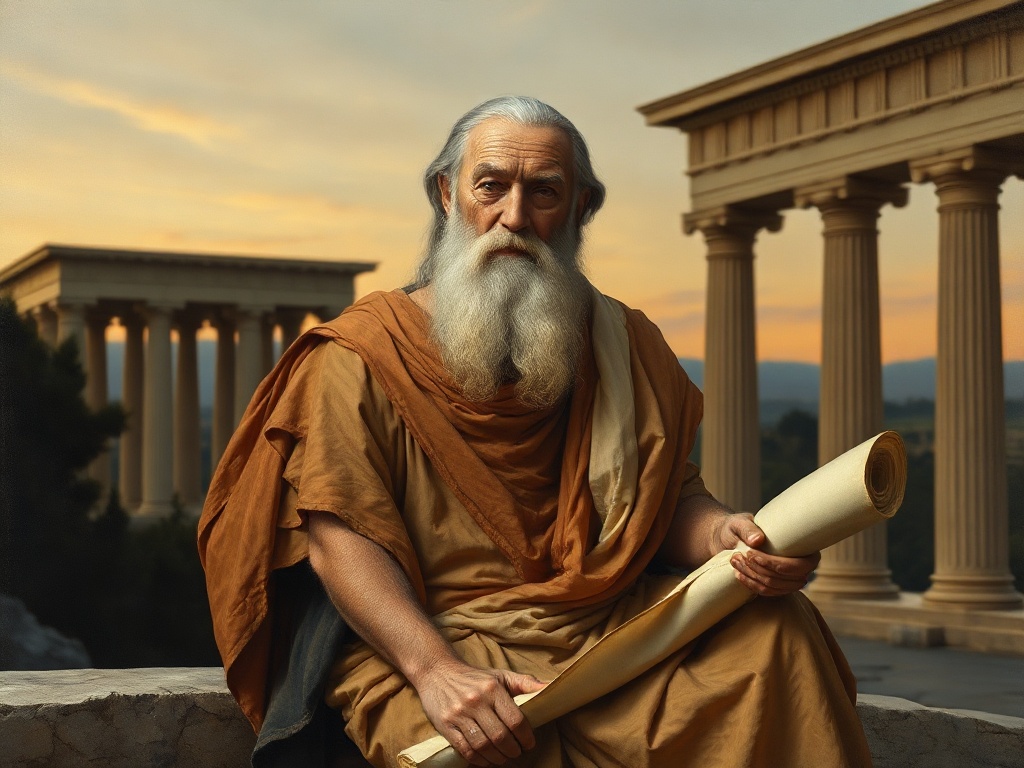
Xenophanes of Colophon (*c. 570 BC – †c. 475 BC) was an Ionian wandering poet, philosopher, and one of the boldest intellectual rebels of Greek antiquity. Born in the Asia Minor city of Colophon, he spent much of his long life as a travelling singer and thinker, carrying his ideas through the Greek world in elegies and satirical verse — including to Sicily and southern Italy, where he profoundly shaped the intellectual climate of Magna Graecia.
Critique of the Anthropomorphic Divine World
His enduring philosophical legacy is his radical critique of the traditional Greek conception of the gods. Xenophanes was among the first to recognise that humans project their own characteristics and moral failings onto the gods. In one of his most celebrated fragments he writes, in essence: "If oxen and horses could paint gods, they would create them in their own image." This observation — the relativity of religious conceptions — was of breathtaking audacity for antiquity and anticipated epistemological debates that would not reach full maturity until centuries later.
Theology and Monotheism
Rather than a multiform pantheon, Xenophanes advocated the idea of a single, indivisible, and supreme god, subject to neither human form nor human passions. This god moves all things through pure intellect — "all eye, all mind, all ear." In doing so, Xenophanes laid an important cornerstone for what would later be called philosophical theology.
Significance for Stoicism
The influence of Xenophanes on Stoic philosophy can scarcely be overstated. The Stoics — above all Zeno of Citium, Cleanthes, and Chrysippus — built upon his idea of a rational, all-encompassing deity, which they identified with the Logos — the divine principle of reason. The Stoic rejection of anthropomorphic gods and the conviction that the divine operates as universal reason throughout the entire cosmos are barely conceivable without the pioneering work of Xenophanes.
Epistemology and Humility
Equally remarkable is his epistemic humility: Xenophanes distinguished between certain knowledge and mere opinion (doxa). He held that humans can never attain absolute certainty about the gods or the world — a thought that lives on in Academic Scepticism and, indirectly, in Stoic epistemology.
Xenophanes of Colophon thus stands at the crossroads of mythos and logos. As a poet-philosopher, he embodies that rare type of ancient thinker who wielded verse and reason in equal measure, and whose ideas radiated far beyond his own time.