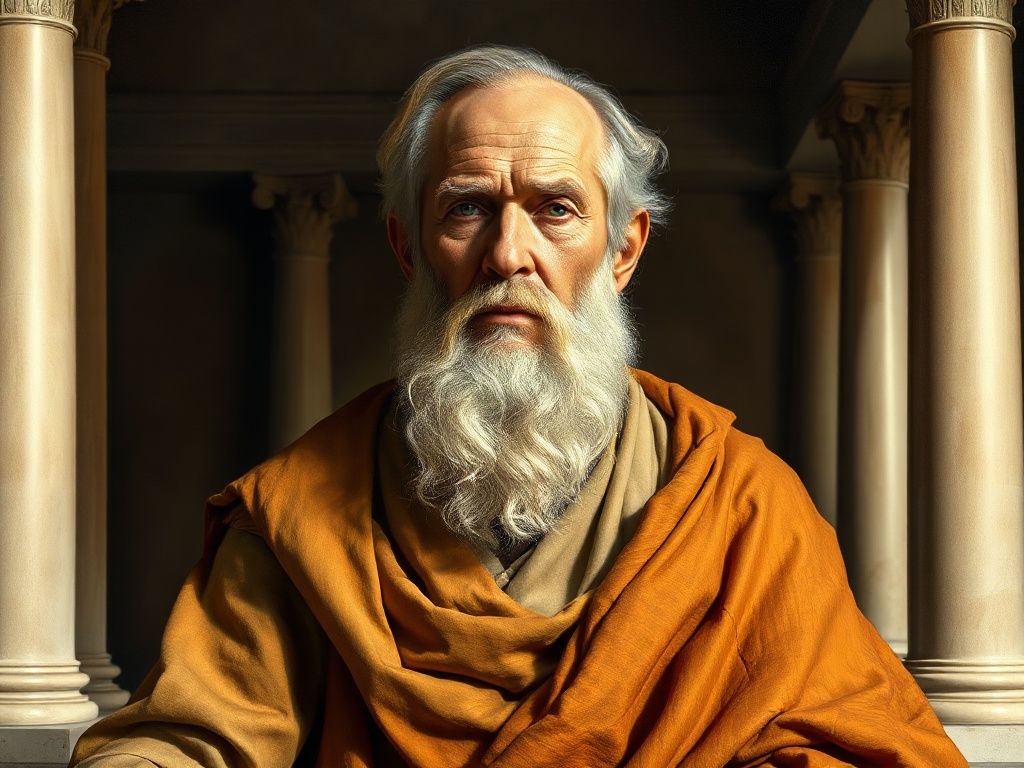
Socrates (469–399 BC)
Socrates is regarded as one of the most significant figures in the history of Western philosophy and as a spiritual forerunner of the Stoic school. Born around 469 BC in Athens as the son of the sculptor Sophroniscus and the midwife Phaenarete, he grew up in a city that had developed into the cultural centre of the Greek world.
Life and Personality
Socrates left no writings of his own; his thought has been transmitted almost exclusively through the dialogues of his pupil Plato, as well as through Xenophon and Aristophanes. His outward appearance — unkempt, barefoot, dressed in a simple garment — was itself a philosophical statement: he embodied needlessness and self-sufficiency (autárkeia) not as theory but as lived practice. He despised material wealth and preferred to engage in discussion in the Athenian agora rather than pursue riches or power.
Enkrateia – The Model of Self-Mastery
Particularly formative for the later Stoic tradition was Socrates' embodiment of enkrateia — self-mastery, or the governance of one's own impulses and desires. Xenophon portrays him in the Memorabilia as someone who endured hunger, thirst, cold, and heat with equanimous composure. This attitude of inner strength in the face of external adversity became a cornerstone of Stoic ethics: Epictetus, Marcus Aurelius, and Seneca drew explicitly on the Socratic model.
Philosophical Method and Stoic Resonance
The Socratic method — the dialogical examination of beliefs (elenchos) with the aim of arriving at true knowledge and thereby at virtue (areté) — anticipates the Stoic ideal of living in accordance with reason (logos). Socrates held the thesis that virtue is knowledge ("No one does wrong willingly"), a conviction that the Stoics adopted and systematised. For both traditions, the life lived virtuously is the only truly good life.
Death and Legacy
In 399 BC, Socrates was condemned to death by an Athenian jury on charges of impiety and corrupting the youth. He accepted the verdict with Stoic equanimity, refused to flee, and drank the hemlock. This end — the calm acceptance of death as an expression of philosophical consistency — was cited by the Stoics as a paradigmatic example of the eudaimonia of the wise man.
Socrates remained for generations of Stoic thinkers the living ideal: a person whose character, courage, and moderation demonstrated that inner freedom is possible regardless of external circumstances.