Gaius Musonius Rufus
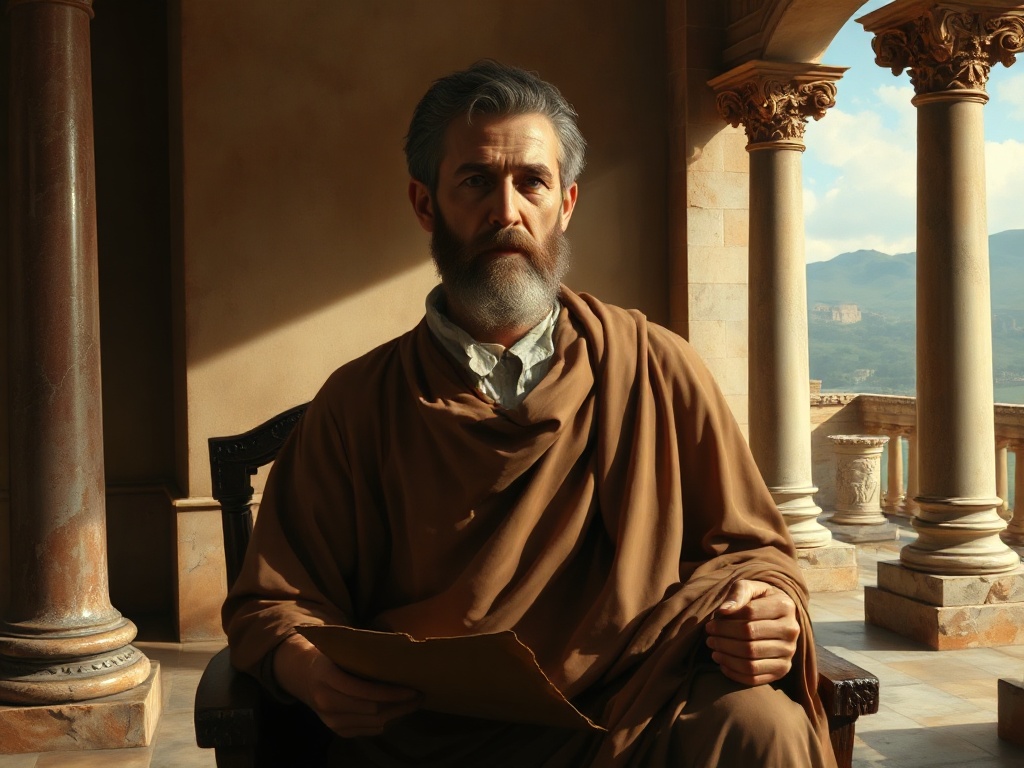
Gaius Musonius Rufus, born around 30 AD in Volsinii (present-day Bolsena in Etruria) and died around 100 AD, ranks among the most important Stoic philosophers of the Roman Imperial Period. Often referred to as "the Roman Socrates," he embodied like few others the unity of philosophical thought and lived virtue.
Origins and Life
As a member of the Roman equestrian order (ordo equester), Musonius enjoyed a privileged position that nonetheless failed to shield him from political turmoil. Under Emperor Nero he was sent into exile — first to Gyaros, a barren island in the Aegean — a fate he bore with Stoic equanimity and which hardened rather than shook his convictions. Under Emperor Vespasian he again faced the threat of banishment. These experiences are directly reflected in his philosophy: Musonius taught that external adversity can do nothing to the truly virtuous person.
Philosophical Thought
Musonius Rufus was an uncompromising proponent of practical Stoicism. Unlike some of his contemporaries, he placed little value on abstract theory or dialectical subtleties. For him, philosophy was above all an art of living — a daily exercise (askēsis) in virtue, self-discipline, and reason. He emphasized that philosophical knowledge is worthless if it does not find expression in action.
Particularly remarkable were his progressive views on equality: Musonius argued that women should receive the same philosophical education as men, since virtue is not the privilege of one sex. He likewise advocated modesty in diet, dress, and conduct — luxury and excess he regarded as enemies of virtue.
Teacher of Epictetus
His most significant legacy is perhaps the shaping of his most famous student: Epictetus, who came to him as a slave and through Musonius's teaching became one of the great Stoics of late antiquity. Musonius taught orally; his thoughts were recorded by students and handed down in so-called diatribes — short, incisive discourses on subjects such as exile, marriage, diet, and the role of women.
Significance and Influence
Musonius Rufus represents a Stoicism that does not exhaust itself in scholarship but must prove itself in everyday life. His writings continue to influence debates on ethics, asceticism, and the social role of philosophy to this day. He remains a shining example that true strength lies not in power or wealth, but in the unyielding force of reason and character.