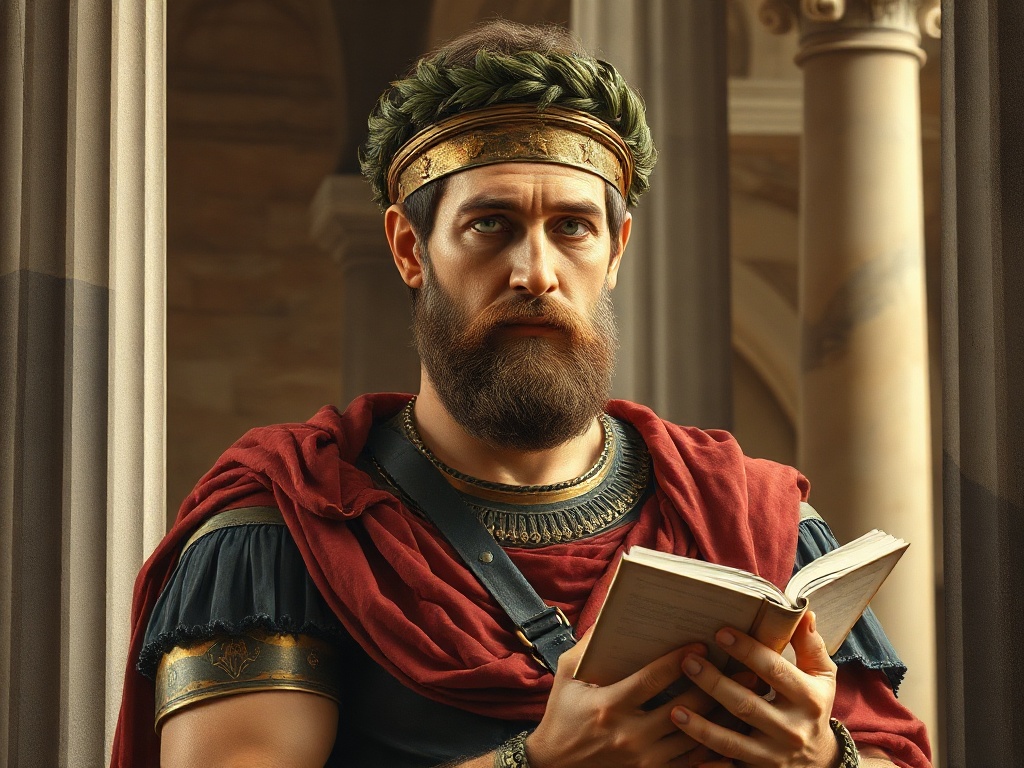
Marcus Aurelius (121–180 AD)
Marcus Aurelius Antoninus is regarded as one of the greatest representatives of Late Stoic philosophy and, at the same time, as one of the most capable rulers of the Roman Empire. Born on 26 April 121 AD in Rome, he came from a distinguished Hispanic family and was identified early on by Emperor Hadrian as a future successor to the throne. His actual adoptive father was Antoninus Pius, under whose tranquil reign Marcus Aurelius received a comprehensive education in rhetoric and philosophy.
Path to Stoicism
Decisive for his intellectual life was his encounter with the philosopher Quintus Junius Rusticus, who introduced him to the writings of Epictetus. The Discourses of the freed slave from Hierapolis became the philosophical foundation of Marcus Aurelius's own thought. Even as a young man he turned away from rhetoric and toward philosophy — a turning point he describes in his Meditations as liberating.
The Meditations as Stoic Practice
Marcus Aurelius's Meditations (Τὰ εἰς ἑαυτόν, "To Himself") are not a work intended for the public, but a private journal of philosophical exercises. At their centre stands prosoche — attentive self-observation — through which the Stoic daily examines his judgements, impulses, and desires. Marcus Aurelius continually keeps before his eyes the transience of all earthly things (memento mori), exhorts himself to distinguish what "is in our power" (eph' hēmin), and emphasises the duty of fellowship among all rational beings in the spirit of Stoic cosmopolitanism.
Philosophy in the Face of Power
As Emperor (161–180 AD) — initially together with his adoptive brother Lucius Verus — Marcus Aurelius faced enormous challenges: wars against the Parthians and Germanic tribes, devastating plagues (Antonine Plague), and internal revolts. It is precisely in this tension between philosophical ideal and political reality that the distinctive quality of his thought reveals itself: he viewed the office of ruler not as a privilege, but as a kathêkon — a fitting action performed for the good of the whole. Stoicism demanded living in accordance with nature and reason (logos); Marcus Aurelius strove to put this principle into practice every day — on the battlefield as much as in the palace.
Legacy
Marcus Aurelius died on 17 March 180 AD in Vindobona (Vienna) while on campaign. The Meditations, transmitted only after his death, remain to this day among the most widely read works in world literature, bearing witness to how Stoic philosophy can be understood as a lived art of life — not as abstract theory, but as daily, unrelenting work on oneself.