
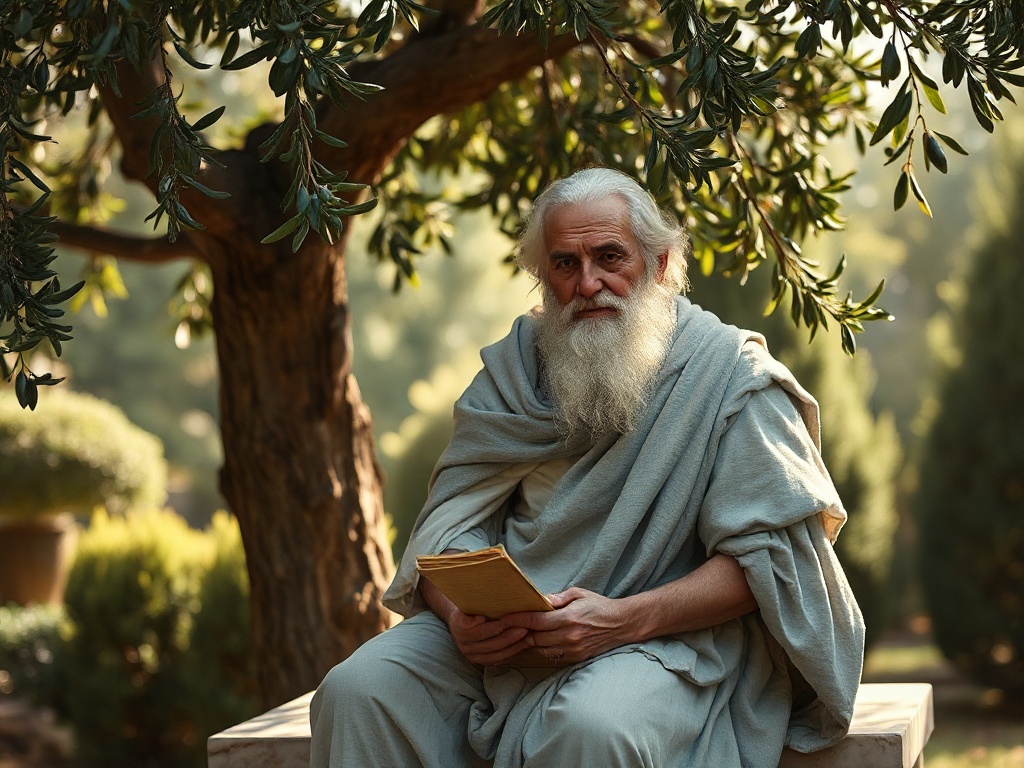
Epicurus (341–270 BC)
Epicurus was a Greek philosopher and founder of Epicureanism, one of the most influential philosophical schools of the Hellenistic world. Born on the island of Samos to Athenian parents, he received an early philosophical education and founded his famous "Garden" (κῆπος / Kepos) in Athens around 306 BC — a philosophical community deliberately situated away from public life and the great institutions of learning such as the Platonic Academy and the Aristotelian Lyceum.
Core Teaching and Life's Goal
The central aim of Epicurean philosophy was the attainment of Ataraxia (tranquility of mind, equanimity) and Aponia (freedom from bodily pain). Epicurus taught that the highest good was pleasure (Hedone) — not, however, in any vulgar hedonistic sense, but as the absence of pain and disturbance. The wise person ought to keep away from political activity, ambition, and public life: "Live in obscurity" (λάθε βιώσας) is the pithy Epicurean principle of life.
Epicurus and the Stoa – A Philosophical Contrast
Epicurus and the Stoa — founded almost simultaneously by Zeno of Citium — constitute the two great rival schools of Hellenism, and scarcely could any contrast be sharper. While the Stoics regarded the human being as a political and social creature whose duty was to be fulfilled within the community, in public office, and in service to the Res publica, Epicurus advocated withdrawal from public life as the path to happiness.
Both schools pursued Eudaimonia (happiness, flourishing) and shared the ideal of the unshakeable sage, yet they differed fundamentally in method: the Stoics held virtue (Arete) to be the only true good and called for active engagement with the world; Epicurus, by contrast, regarded pleasure as the highest good and recommended the deliberate reduction of desires and obligations. The Stoic concept of Oikeiosis — the natural belonging of the human being to the community — stands as a direct antithesis to the Epicurean ideal of withdrawal.
Legacy
Although Epicurus and the Stoics were in many respects regarded as antipodes, the two traditions influenced one another mutually. Later Roman figures such as Cicero, Seneca, and Marcus Aurelius engaged intensively with Epicurus — partly critically, partly with admiration. Seneca, for instance, quoted Epicurus frequently and praised his emphasis on inner freedom, even while rejecting his turning away from the world. Thus Epicurus remained an indispensable interlocutor of Stoic philosophy — as a foil, as a challenge, and occasionally as a quiet ally.