
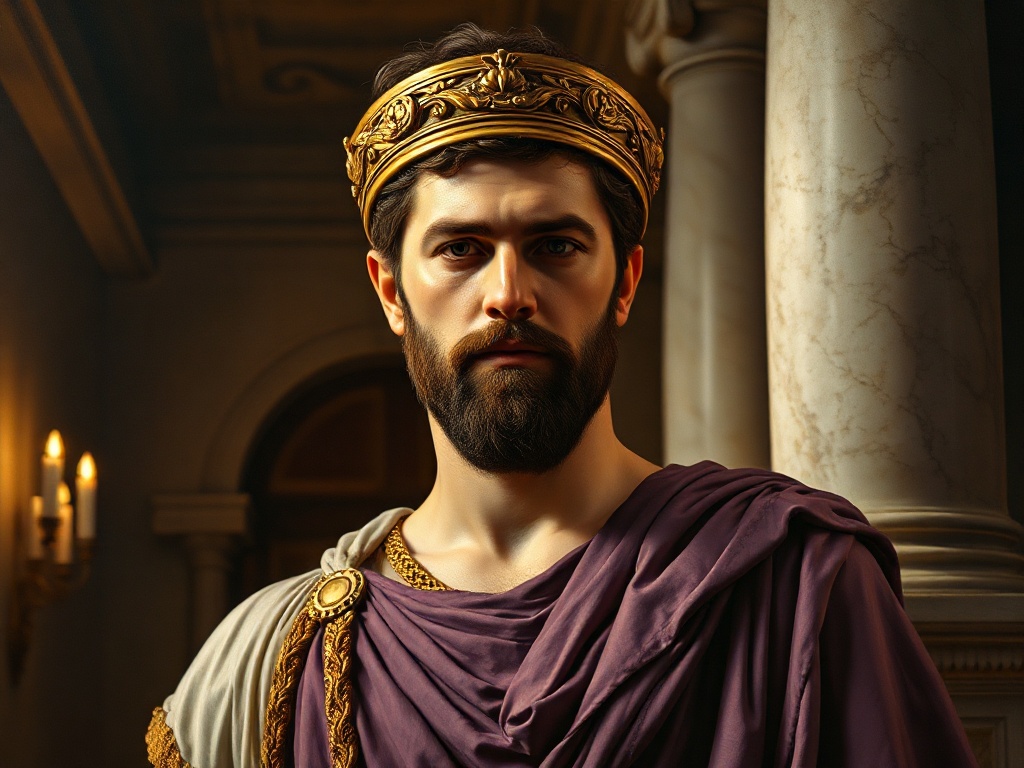
Domitian (51–96 AD)
Titus Flavius Domitianus was Roman emperor from 81 to 96 AD and the last ruler of the Flavian dynasty. As the son of Emperor Vespasian and younger brother of Titus, he ascended the throne after his brother's early death — leaving behind an ambiguous legacy that reaches far beyond political history into the world of ancient philosophy.
Reign and Character
Domitian's reign was marked by an increasingly autocratic style of rule. He demanded divine veneration, had himself addressed as dominus et deus — "Lord and God" — and found himself in growing conflict with the Roman Senate. His rule was portrayed predominantly in a negative light by ancient historians such as Tacitus, Pliny the Younger, and Suetonius, although later scholarship has produced a more nuanced picture: Domitian was an efficient administrator who strengthened the military and organized the provinces with a firm hand.
The Philosophers' Edict and Its Connection to Stoicism
Domitian acquired particular significance in the history of Stoic philosophy through his edict expelling the philosophers from Rome, issued around 89 AD — a year already shaken by the revolt of Antonius Saturninus. The background was the political threat Domitian perceived from philosophical schools: Stoics and Cynics were seen as promoters of a spirit of freedom incompatible with the emperor's claim to absolute authority.
Directly affected by this measure was Epictetus (c. 50–138 AD), the most prominent Stoic of his time. As a former slave who taught philosophy in Rome, he was forced to leave the city. He subsequently settled in Nicopolis in Epirus, where he founded his own philosophical school — one that would make him one of the most influential teachers of late antiquity. His student Arrian preserved Epictetus's teachings in the Discourses and the Enchiridion — works that to this day rank among the foundational texts of Stoic philosophy.
Historical Assessment
Domitian's persecution of the philosophers was thus, paradoxically, a catalytic moment for the spread of Stoic thought: driven out of Rome, Stoicism found its way back into the Greek-speaking world and was able to take root there anew. Domitian himself fell victim to a palace conspiracy and was murdered in September 96 AD. The Senate pronounced the damnatio memoriae upon him — an official condemnation of his memory. Nevertheless, he remains in history as the unwitting trailblazer of one of antiquity's most significant philosophical traditions.