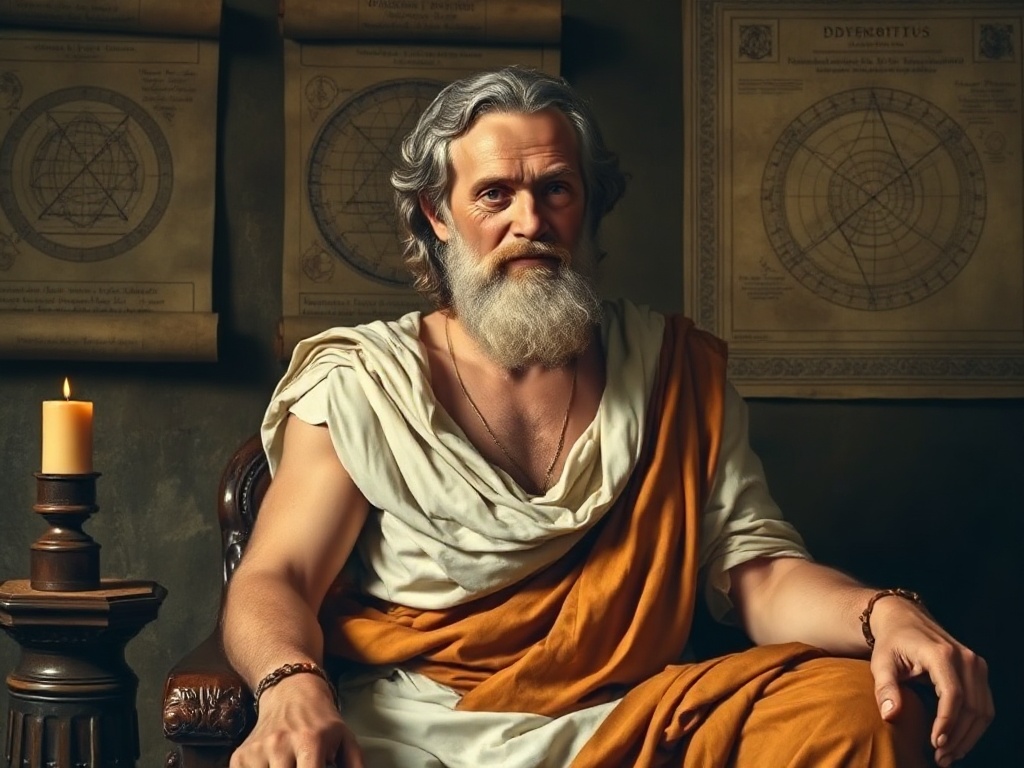
Democritus of Abdera
Democritus (c. 460 BC – c. 370 BC) was one of the most influential natural philosophers of Greek antiquity. Born in Abdera, a colonial city in Thrace, he came from a wealthy family and used his inheritance to undertake extensive travels to the East — to Egypt, Persia, and possibly India. These journeys shaped his encyclopaedic knowledge, which spanned mathematics, physics, astronomy, biology, music, and ethics.
Atomism — The Foundation of His Thought
Together with his teacher Leucippus, Democritus developed atomic theory: all that exists is composed of indivisible, imperishable particles (atoma) and empty space (to kenon). This materialist account of the world, which required no divine intervention, was revolutionary and laid a foundation upon which later schools — most notably the Epicureans — would build. Stoic materialism, which likewise emphasised a corporeal underlying structure of reality, stands in an intellectual kinship with this approach, even though the Stoics added the pneuma as the active principle of the cosmos.
Euthymia — Precursor to Stoic Tranquillity of Soul
Of particular significance in the history of philosophy is Democritus's ethics. He coined the term "euthymia" (εὐθυμία) — literally "good disposition of the soul" or inner equilibrium — as the highest human good. This concept describes a state of serene, composed equanimity, free from fear, excess, and passionate disturbance. The wise person should observe moderation, set little store by external goods, and draw happiness from within.
These ideas constitute a remarkable anticipation of core Stoic thought: the Stoa — founded by Zeno of Citium around 300 BC — likewise taught that true well-being (eudaimonia) depends solely on virtue and inner disposition, not on external circumstances. Democritus's euthymia finds its echo in the Stoic ideals of ataraxia and apatheia — the ideals of equanimity and freedom from passion.
Influence and Legacy
Although scarcely any complete work of Democritus has survived — only fragments and maxims were handed down — his influence was immense. Aristotle wrote about him at length, Epicurus built his philosophy upon Democritean atomism, and later Stoic thinkers such as Seneca and Marcus Aurelius knew and quoted his ethical maxims.
Democritus, referred to by posterity as the "laughing philosopher" — in contrast to the weeping Heraclitus — embodied in his own person the serene composure that he taught: a philosopher who recognised in the transience of all things not sorrow, but freedom.