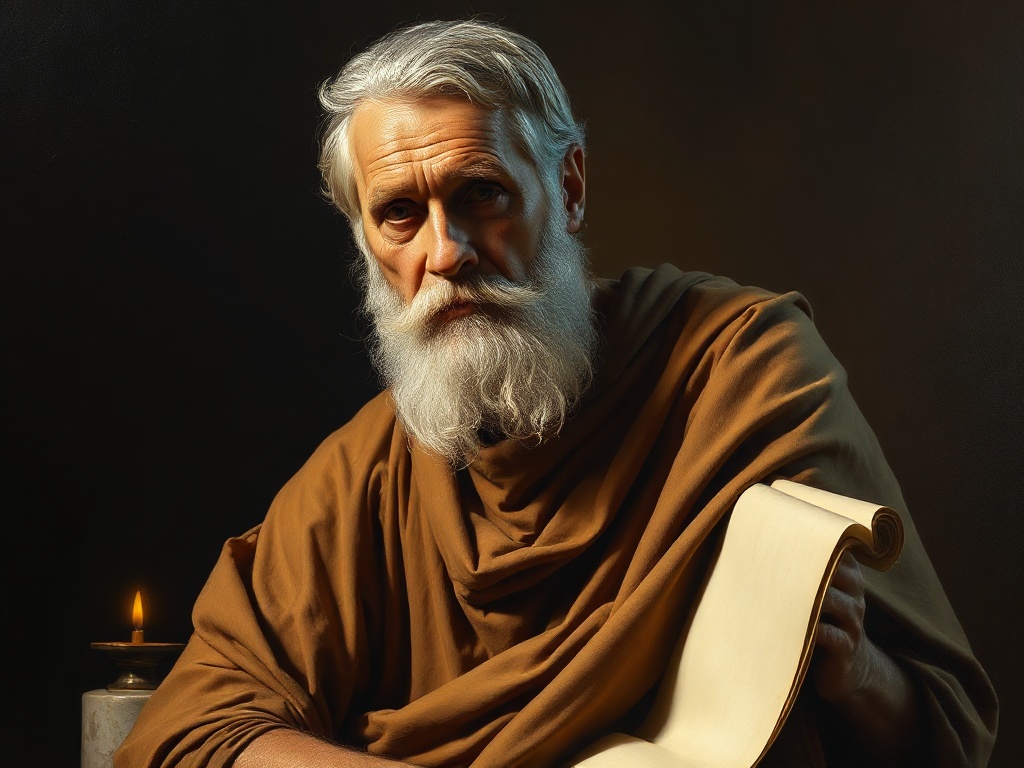
Cleanthes of Assos (c. 330–230 BC)
Cleanthes was born around 330 BC in Assos in the Troad (in present-day northwestern Anatolia). Before turning to philosophy, he reportedly worked as a prizefighter — a background that later Stoics used as a metaphor for intellectual endurance and physical discipline. After arriving in Athens, he joined Zeno of Citium, the founder of Stoicism, and became his most devoted student. In order to support himself while attending his teacher's lectures during the day, he worked as a water-carrier by night — a testament to his unwavering dedication to philosophy.
Successor to Zeno and Head of the Stoa
Following Zeno's death around 262 BC, Cleanthes assumed leadership of the school and led the Stoa for more than three decades. His scholarchate was no mere stewardship of his teacher's legacy; Cleanthes enriched Stoic doctrine with his own emphases, most notably by introducing a profound religious-cosmological dimension. Drawing on Heraclitus's world-principle, he regarded fire as the central element of the divine Logos that permeates and orders the entire universe.
Contribution to Apatheia
Cleanthes' most significant philosophical contribution lies in the refinement of the concept of Apatheia (ἀπάθεια). The Stoics understood this not as indifference in the modern sense, but as freedom from irrational passions (pathē) that cloud rational judgment. Cleanthes emphasized that genuine virtue is only attainable when a person learns to govern their inner impulses through reason. Apatheia thus denotes the active, deliberate control over one's reactions to external events — not insensibility, but inner steadfastness.
Hymn to Zeus
His best-known surviving work is the Hymn to Zeus, a poem of great religious depth and literary quality that celebrates the unity of the cosmos under a divinely rational principle. This work is regarded as the most important fully preserved document of the early Stoa and demonstrates how Cleanthes united philosophy and piety.
Legacy
Cleanthes led the Stoa until his death around 230 BC, passing the school on to Chrysippus of Soli, who would go on to develop Stoic philosophy in a systematic manner. Despite Chrysippus's later dominance, Cleanthes is remembered as the moral conscience of the early Stoa: a thinker whose very life was a philosophical argument — for endurance, simplicity, and the power of reason.