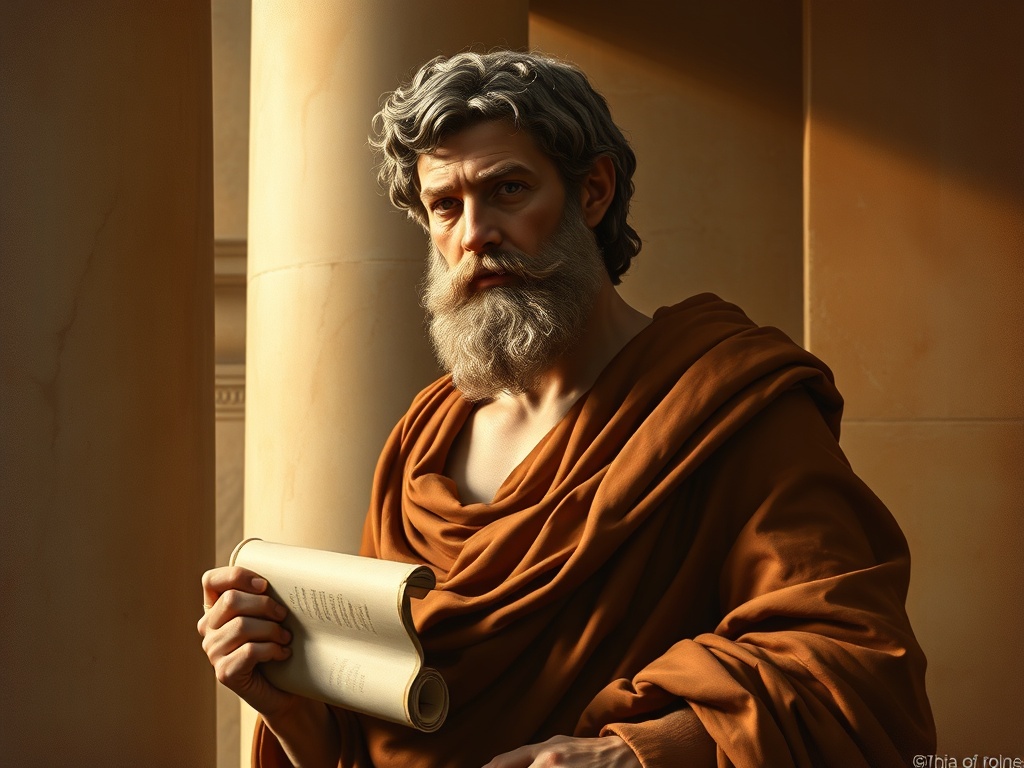
Aristotle (384–322 BC)
Aristotle is considered one of the most influential thinkers in the entire history of philosophy. Born in Stageira in northern Greece, he came to Athens at the age of seventeen, where he spent nearly two decades at Plato's Academy – first as a student, later as an independent thinker. After Plato's death (347 BC) he left Athens, spent several years at the court of the Macedonian king Philip II as tutor to the young Alexander, and finally founded his own school in Athens in 335 BC: the Lyceum.
Philosophical Work and Significance for Stoicism
Aristotle left behind an encyclopaedic body of work encompassing logic, natural philosophy, metaphysics, ethics, politics, rhetoric, and poetics. For the later Stoic tradition, his practical philosophy was of particular importance. In his ethical writings – above all the Nicomachean Ethics – he developed a virtue-based moral philosophy centred on the concepts of Eudaimonia (happiness/flourishing), Arete (virtue), and Praxis (purposive action). These concepts formed a significant sounding board for the early Stoics, even though the latter diverged from him on key points.
Of special importance is Aristotle's use of the term Prohairesis – the conscious, reason-guided decision or act of will. While Aristotle understood prohairesis within his theory of virtue and action as the faculty of deliberate choice, the later Stoic philosopher Epictetus took up this term and gave it a more radical, more central position: for Epictetus, prohairesis was the only domain lying entirely within our power – the very core of free will and the moral identity of the human being. Without intending it, Aristotle thereby laid a conceptual foundation upon which the Imperial Stoics erected one of their most distinctive concepts.
Relationship to Stoicism
Stoicism and Aristotelianism stood in a relationship that was at once tension-filled and mutually enriching, at times competitive and at times fertile. The Stoics adopted from Aristotle the emphasis on reason as the guiding principle of the good life, as well as formal logic, yet they developed their own syllogistic and firmly rejected Aristotle's distinction between external goods and virtue. For the Stoics, virtue alone is the good – a position that considerably sharpened the Aristotelian doctrine of Eudaimonia.
Aristotle's thought thus functioned as an indispensable interlocutor against whom the Stoic school honed and defined itself – a legacy that remained palpable right through to the Roman Stoicism of Cicero, Seneca, and Epictetus.